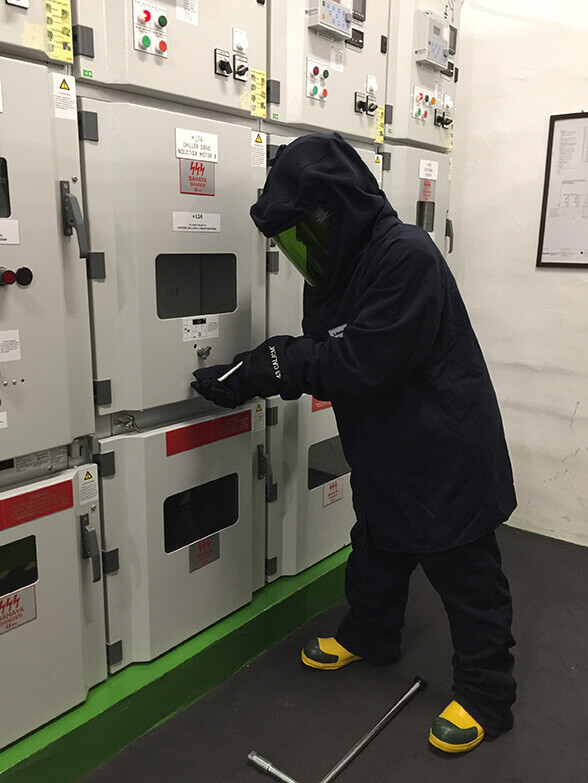
 Risk assessments in general have been required by OSHA for decades, and arc flash risk assessments have been required by the NFPA-70E for nearly as long. Protective apparel for qualified electrical persons is also required, and the only way to have certainty in what level of protection is adequate is to perform and incident energy analysis, commonly referred to as arc flash risk assessment.
In performing an arc flash risk assessment, the actual system parameters of a facility’s electrical system are collected and recorded, the utility system power contribution verified with the power company, and precise calculations are performed based on the electrical system components installed within the facility. While other approaches are allowed, the incident energy analysis method is the most reliable and provides the most accurate information so that application of protective apparel isn’t a guessing game.
Ready for one of our Arc Flash Risk Assessments? Get Started Today!
The Keynext Team has been delivering arc flash risk assessment services for nearly as long as it’s been available. Our key providers were trained directly by the engineers who developed the incident energy analysis method and hold certifications from the NFPA in electrical safety compliance. Our team has delivered hundreds of arc flash risk assessments in facilities in all business sectors and various system sizes.
Along with incident energy analysis, devoice coordination is an important engineering evaluation. Proper coordination of protective devices can result in lower incident energy levels and will help ensure that electrical faults are isolated as close to their source as possible, resulting in a reduction in nuisance tripping of circuit breakers.
Let Keynext be your electrical engineering solutions provider.
When do I need an arc flash risk assessment?
The purpose of an arc flash risk assessment is to determine the levels of energy released in the event of an arcing fault so that qualified personnel can apply appropriate levels of protective apparel when performing work where an arc flash risk exists. The goal is to collect your system’s data so it can be modeled, and analyzed to identify potential hazards, calculate incident energy, determine safe approach distances, and correct PPE selection.
As you approach the five-year mark, don’t compromise your facility’s electrical system or your employees’ safety by neglecting your arc flash risk study. With Keynext, we will maintain and manage your facilities, ensuring your electrical systems are up to date and running properly.
Grounding & Bonding Testing