
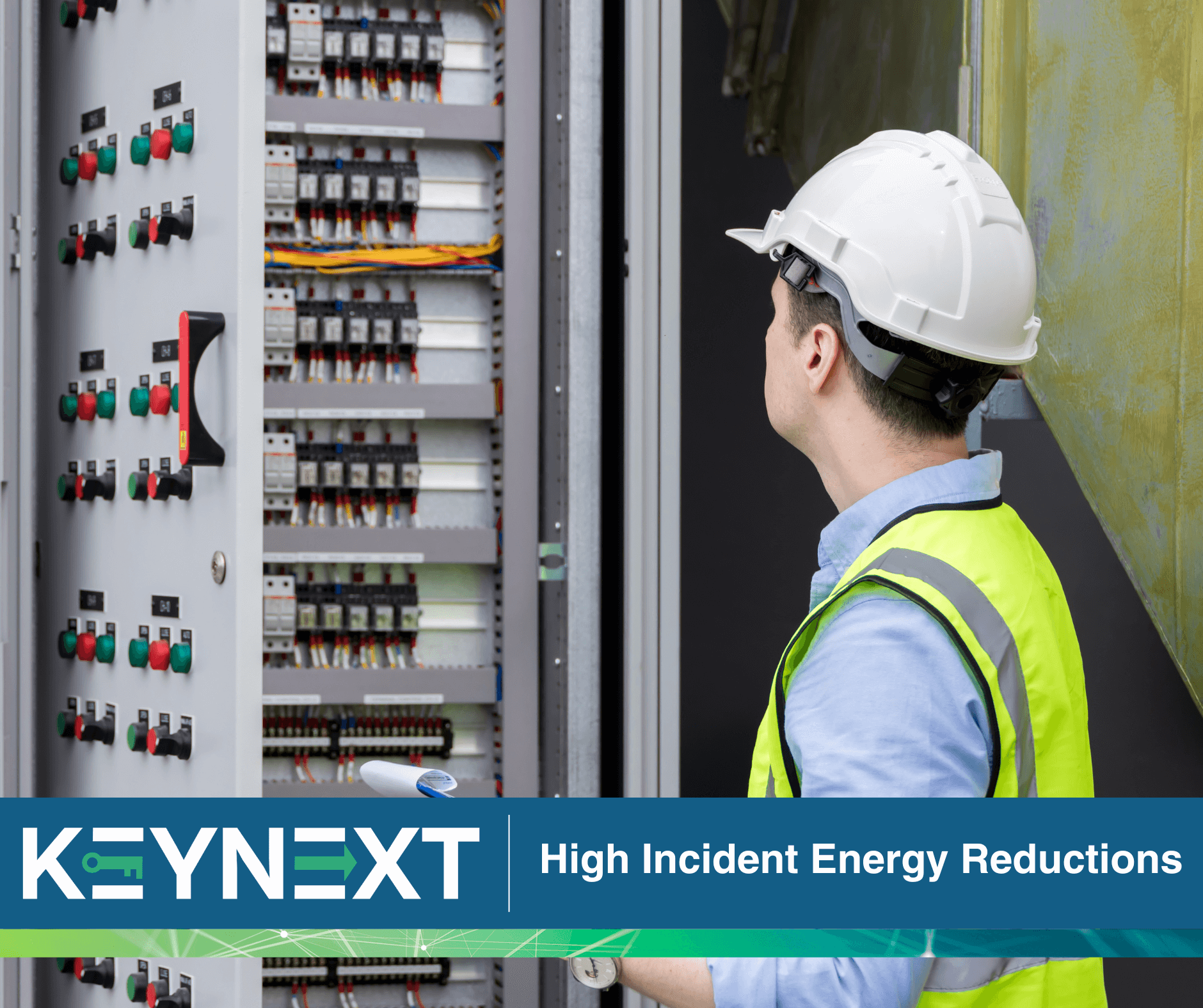
After completing your arc flash risk assessment, you may discover that your required PPE levels are extremely staggering and the incident energies throughout the system are excessively high. So, what can you do? Fortunately, Keynext offers several cost-effective solutions that significantly reduce incident energy levels without straining your budget.
Zone-Selective Interlocking 
The first service option, the ZSI system, commonly known as “zone-selective interlocking,” is a smart protection feature used in electrical distribution systems to improve safety and system uptime during short circuits or ground faults. Circuit breakers should be configured with two distinct settings: one optimized for standard operational conditions and another designed to minimize arc flash risk during maintenance or equipment interfacing. In such instances, the ZSI system’s enabling allows for lower thresholds for trip-setting so that any fault will clear more quickly than in normal operations and only the closest breaker to the fault trips. Keynext can help implement ZSI systems to improve your systems’ selective coordination. We can provide this type of protection by adding aftermarket devices or newer circuit breaker trip units equipped with this setting. With a ZSI system, your electrical systems can maintain fast fault clearing times and reduce system downtime while enhancing the safety of your facility.
Instantaneous Trip Override
Another mitigation measure associated with circuit breakers and circuit breaker settings is the “instantaneous trip override.” This setup allows the instantaneous trip setting to be disabled during maintenance operations while the other safety trip settings, short time, long time, and ground fault, remain enabled to maintain safety. However, during the time that this method is utilized, the functions of selective coordination won’t apply, which needs to be taken into consideration before choosing this method.
 Thermal-Magnetic Only Circuit Breakers
Keynext offers an alternative method, particularly suitable for older electrical systems, which involves updating the protective devices within the system itself. Many facilities, whether have thermal-magnetic only circuit breakers, exclusively use fuses as protective devices or employ a combination of both. Older electrical systems were limited by the available technology when they were designed and built. More modern protective devices have features that allow them to adequately protect against faults as well as be selectively coordinated to isolate and clear faults much faster than protective devices that are 20 to 30 years old. Electronic trip units and relays are much more suited to arc flash mitigation schemes than older devices. This solution may not be as cost-effective, but it will offer a return on investment in safer working conditions for older electrical systems.
No matter which solution your business is considering, it’s essential that you partner with an electrical service provider who understands the complexities of electrical system design and can help you choose the most effective option. Our key providers were trained directly by the engineers who developed the incident energy analysis method and hold certifications from the NFPA in electrical safety compliance. Our Keynext team has delivered hundreds of arc flash risk assessments in facilities in all business sectors and various system sizes.
If your incident energy levels exceed acceptable standards, we’re here to help you find a safer, smarter path forward.