
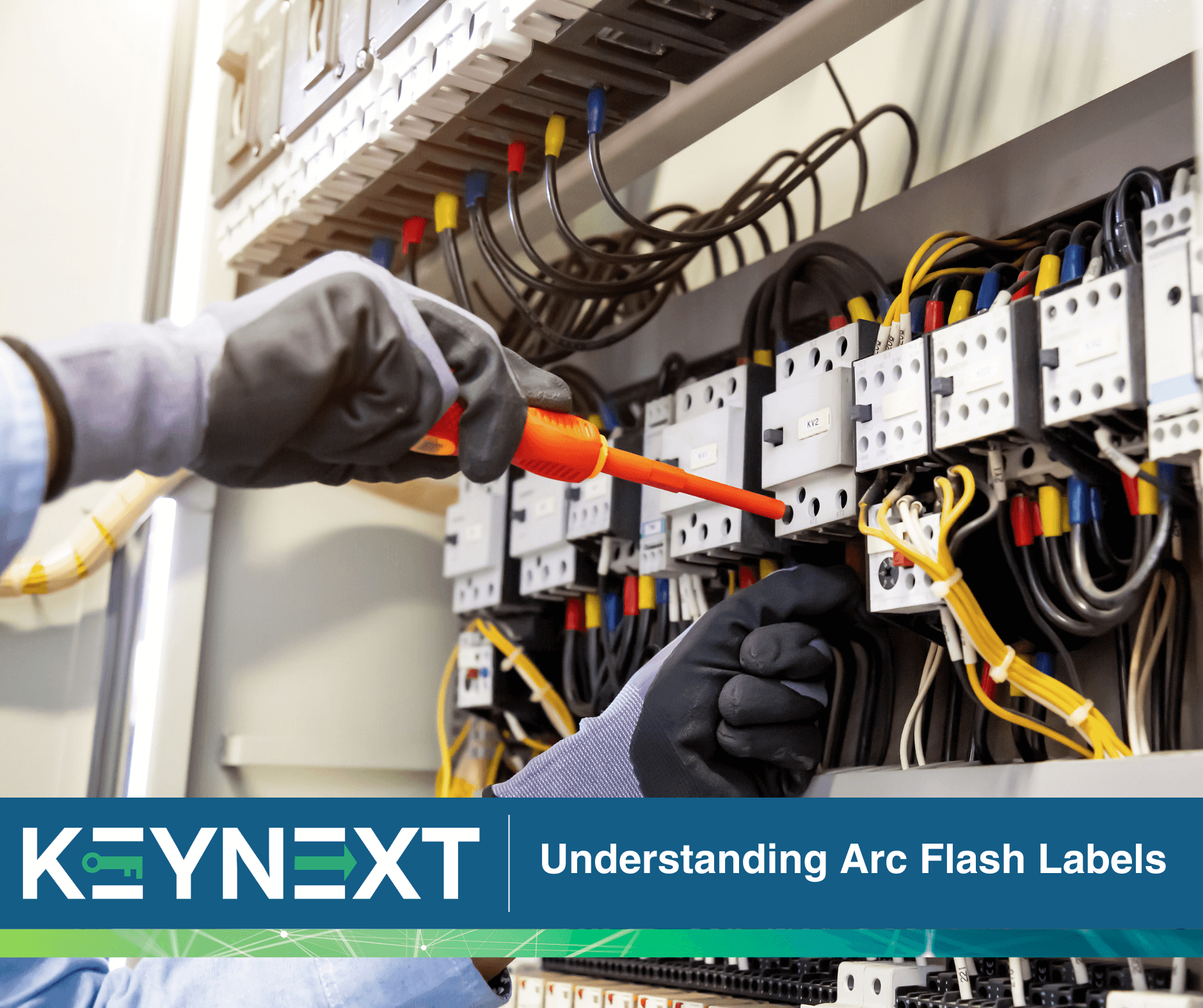
Arc flash label configurations are one of those topics around which there always seems to be a shroud of mystery. Often, there is speculation surrounding the results of the studies, and confusion about the data on labels. At Keynext LLC, we would like to take a moment to address one point that seems to be more commonly misunderstood.
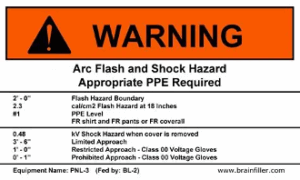 This is a fairly standard arc flash label configuration. The NFPA-70E specifies the information that needs to be on the label, but several variations of design meet the criteria.
Listed above is the device name, Flash Hazard Boundary, and incident energy at the working distance, along with the Shock Hazard data, which is also nice to have. Where people seem to be confused, though, isn’t with what’s included on the labels, but when labels on seemingly similar devices where the arc flash values don’t match.
Recently, we were asked about two identical machines that had control panels associated with them. The two machines performed identical functions, were located directly beside one another, and were configured identically. However, when comparing their arc flash labels, one had a much higher incident energy than the other. The lead electrician for this facility raised concerns about the validity of the study, questioning whether their arc flash numbers should be the same.
This is a common misconception among those unfamiliar with how arc flash incident energies are calculated. The function of a particular electrical device, its current rating, its load, or its internal electrical configuration has nothing to do with its arc flash rating. When you consult an arc flash label for a device, you’re reading the arc flash values for that device where its incoming power connects to it.
The values that drive these characteristics are based on the electrical properties of the protective device upstream from that point. It is entirely possible that it happens with great regularity to have a lineup of identical electrical devices, whether circuit breaker panels, machine control panels, or disconnect switches, all at the same voltage and current ratings, and each has some variance in its arc flash numbers, due to the differences in the electrical feed.
 In the case of the control panels pictured to the left, they were supplied from the same distribution panel and were fed by breakers with the same current rating. However, one was older and was a thermal magnetic-only molded case breaker. The other machine was fed from a more recently updated circuit that was protected by a circuit breaker with trip adjustments.
The clearing curves of those two breakers were significantly different. That difference was enough to result in a significant variance in incident energy, as one would clear an arcing fault in approximately one-quarter the time it took the other. Clearing time is one of the variables that drives incident energy, so having a difference easily drives a contrast in the information one would see on a label. Don’t assume that identical devices should have identical arc flash labels. Like an iceberg, it’s not only what you see that should concern you; there’s more underneath.
At Keynext, LLC, we are here to answer your questions and help you understand any of our services and maintenance solutions.
Have a question? Contact us today to connect with our team >
Gain valuable insights from Keynext, LLC, by reading our latest blogs here >